Basic Digital Arts - DMS 121
Department of Media Study, SUNY at Buffalo
SUMMER 2007
Class: MTWR 11:00 - 1:00
Instructor: Al Larsen
Office Hour: Tuesdays 1:00 - 2:00 (CFA 244 &/or CFA 271)
alarsen * at * buffalo * dot * edu
Labs & Lessons
5/21/07:
Introductions... overview of the course
a handful of examples of approaches to working with digital media:
Thomson & Craighead - Short Films About Flying
Y H Chang
Ferry Halim
Susan Collins - Glenlandia
Read this for next class:
digital imaging nuts and bolts (pdf)
Introductions... overview of the course
a handful of examples of approaches to working with digital media:
Thomson & Craighead - Short Films About Flying
Y H Chang
Ferry Halim
Susan Collins - Glenlandia
Read this for next class:
digital imaging nuts and bolts (pdf)
5/22/07:
Review/discuss: digital imaging nuts and bolts
Chariots of Mortal Kombat Fire
Lab:
hands-on Photoshop
Review/discuss: digital imaging nuts and bolts
Chariots of Mortal Kombat Fire
Lab:
hands-on Photoshop
5/23/07:
Lecture:
visual art primer (flash)
Lecture:
Collage
Lecture:
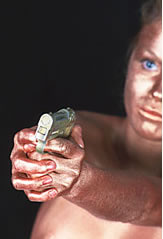
Photomontage
photo montage pdf

Lab:
hands-on Photoshop
Lecture:
visual art primer (flash)
Lecture:
Collage
Lecture:
Photomontage
photo montage pdf
Lab:
hands-on Photoshop
5/24/07:
Discussion:
article: "Is a Cineam Studies Degree the New MBA?"
Lecture:
abstraction, symbol, representation: visual message (powerpoint)
ATPM site with example of gestalt theory
Lab: grouping layers, text tools in Photoshop, using Masks
Photoshop CS - Masks
Photoshop CS - placing text on a path
Photoshop - text effects
Open work time.
Discussion:
article: "Is a Cineam Studies Degree the New MBA?"
Lecture:
abstraction, symbol, representation: visual message (powerpoint)
ATPM site with example of gestalt theory
Lab: grouping layers, text tools in Photoshop, using Masks
Photoshop CS - Masks
Photoshop CS - placing text on a path
Photoshop - text effects
Open work time.
MORE ON... Vector and Bitmap (from Adobe documentation)
Computer graphics fall into two main categories—bitmap and vector. You can work with both types of graphics in Photoshop and ImageReady; moreover, a Photoshop file can contain both bitmap and vector data. It’s helpful to understand the difference between the two categories as you create, edit, and import artwork.
Bitmap images—technically called raster images—are made up of a grid of dots known as pixels. When working with bitmap images, you edit pixels rather than objects or shapes. Bitmap images are the most common electronic medium for continuous-tone images, such as photographs or digital paintings, because they can represent subtle gradations of shades and color.
Bitmap images can lose detail when scaled on‑screen because they are resolution-dependent, they contain a fixed number of pixels, and each pixel is assigned a specific location and color value. Bitmapped images can look jagged if they’re printed at too low a resolution because the size of each pixel is increased.
Vector graphics
Vector graphics are made up of mathematically defined lines and curves called vectors. You can move, resize, or change the color of a line without losing the quality of the graphic.
Vector graphics are resolution-independent—that is, they can be scaled to any size and printed at any resolution without losing detail or clarity. As a result, vector graphics are the best choice for representing bold graphics that must retain crisp lines when scaled to various sizes (logos, for example).
Example of a vector graphic at different levels of magnification
Note: Because computer monitors can display images only on a grid, both vector graphics and bitmap images are displayed as pixels on-screen.
Tuesday, May 29
Photoshop - crop, resize canvas, guides, history brush
diptych examples:
DEFINE: 2 panel artwork ... hinge
http://meltingpot.fortunecity.com/ukraine/324/martini.jpg
Russian Orthodoz diptych icon:
http://www.russian-victories.ru/
-------------
http://www.nga.gov/exhibitions/diptychinfo.shtm
"This exhibition, the first devoted to the subject, will bring together almost 36 pairs of Netherlandish panel paintings from the 15th and 16th centuries, including works from public and private collections in Europe and the United States. Unfortunately, the diptych format—essentially two hinged panels that can be opened and closed like a book—was vulnerable to alteration, even the separation and dispersal of the panels. The exhibition will reunite several paintings now owned by different institutions, such as Rogier van der Weyden's Virgin and Child from California with his portrait of Philippe de Croy from Antwerp (c. 1460), and Michael Sittow's Virgin and Child from Berlin with his portrait of Diego de Guevara (?) from the National Gallery of Art (c. 1515/1518). Both of these diptychs are examples of a popular theme that showed a donor portrayed on one panel praying to holy personnages depicted on the other panel. Such diptychs, often small in size, were used for private devotion."
----------------
Carrie Mae Weems:
http://www.ppowgallery.com/artists/CarrieMaeWeems/fromhere.html
Warhol (Marilyn)
http://www.britannica.com/eb/art-16807
"Marilyn Monroe died in August 1962. In the following four months, Warhol made more than twenty silkscreen paintings of her, all based on the same publicity photograph from the 1953 film Niagara. Warhol found in Monroe a fusion of two of his consistent themes: death and the cult of celebrity. By repeating the image, he evokes her ubiquitous presence in the media. The contrast of vivid colour with black and white, and the effect of fading in the right panel are suggestive of the star’s mortality."
http://www.tate.org.uk/collection/T/T03/T03093_8.jpg
--------------------------------------------------
Formal relationship between panels...
http://www.gilleslarrain.com/html/series/dyptichs/series_dyptichs_1.html
-------------------------------------------------------
Keith Cotton
http://www.keithcotton.com/diptych.htm
Photoshop - crop, resize canvas, guides, history brush
diptych examples:
DEFINE: 2 panel artwork ... hinge
http://meltingpot.fortunecity.com/ukraine/324/martini.jpg
Russian Orthodoz diptych icon:
http://www.russian-victories.ru/
-------------
http://www.nga.gov/exhibitions/diptychinfo.shtm
"This exhibition, the first devoted to the subject, will bring together almost 36 pairs of Netherlandish panel paintings from the 15th and 16th centuries, including works from public and private collections in Europe and the United States. Unfortunately, the diptych format—essentially two hinged panels that can be opened and closed like a book—was vulnerable to alteration, even the separation and dispersal of the panels. The exhibition will reunite several paintings now owned by different institutions, such as Rogier van der Weyden's Virgin and Child from California with his portrait of Philippe de Croy from Antwerp (c. 1460), and Michael Sittow's Virgin and Child from Berlin with his portrait of Diego de Guevara (?) from the National Gallery of Art (c. 1515/1518). Both of these diptychs are examples of a popular theme that showed a donor portrayed on one panel praying to holy personnages depicted on the other panel. Such diptychs, often small in size, were used for private devotion."
----------------
Carrie Mae Weems:
http://www.ppowgallery.com/artists/CarrieMaeWeems/fromhere.html
Warhol (Marilyn)
http://www.britannica.com/eb/art-16807
"Marilyn Monroe died in August 1962. In the following four months, Warhol made more than twenty silkscreen paintings of her, all based on the same publicity photograph from the 1953 film Niagara. Warhol found in Monroe a fusion of two of his consistent themes: death and the cult of celebrity. By repeating the image, he evokes her ubiquitous presence in the media. The contrast of vivid colour with black and white, and the effect of fading in the right panel are suggestive of the star’s mortality."
http://www.tate.org.uk/collection/T/T03/T03093_8.jpg
--------------------------------------------------
Formal relationship between panels...
http://www.gilleslarrain.com/html/series/dyptichs/series_dyptichs_1.html
-------------------------------------------------------
Keith Cotton
http://www.keithcotton.com/diptych.htm
Tuesday, May 29
Photoshop - ???
digital self-portrait examples
13 Most Beautiful Avatars - by Eva and Franco Mattes a.k.a. 0100101110101101.ORG
The photos in Self-Portrait come from a software search through the millions of photos on flickr.com. Using facial-recognition, the software seeks out photos that are likely to contain the artist Ethan Ham. Self-Portrait takes the mechanical process of photography and extends the machine's role to include editorial selection.
"Self-Portrait" is a 2006 commission of New Radio and Performing Arts, Inc. (aka Ether-Ore) for its Turbulence website. It was made possible with funding from the Jerome Foundation.
http://transition.turbulence.org/Works/self-portrait/
Chuck Close
http://www.miamiartexchange.com/miami_art_articles/miami_art_articles_2005/self-portraiture.html
http://www.tfaoi.com/aa/6aa/6aa176.htm
Cindy Sherman
Nikki S Lee
Photoshop - ???
digital self-portrait examples
13 Most Beautiful Avatars - by Eva and Franco Mattes a.k.a. 0100101110101101.ORG
The photos in Self-Portrait come from a software search through the millions of photos on flickr.com. Using facial-recognition, the software seeks out photos that are likely to contain the artist Ethan Ham. Self-Portrait takes the mechanical process of photography and extends the machine's role to include editorial selection.
"Self-Portrait" is a 2006 commission of New Radio and Performing Arts, Inc. (aka Ether-Ore) for its Turbulence website. It was made possible with funding from the Jerome Foundation.
http://transition.turbulence.org/Works/self-portrait/
Chuck Close
http://www.miamiartexchange.com/miami_art_articles/miami_art_articles_2005/self-portraiture.html
http://www.tfaoi.com/aa/6aa/6aa176.htm
Cindy Sherman
Nikki S Lee
7/5/07
review of audio terms
then... audio concepts and using Audacity
The program we will be using for audio is Audacity. It is a freely distributed program, and if you wish you can download it for use on your home computer.
in-class exercise...
download one or more of the beats below... import it into Audacity and manipulate it...
these beats were created by PJ Burnhill (site) and are issused under creative commons "Attribution" license (details)
What is a Wave?
sound waves.
... and just listen to the audio clips from: Reverb in a small room
...for further reading, this page on Superposition is pretty interesting too.
For Wednesday, read two tutorials, Basics - Digital Audio and Basics - Rules of Audacity.
review of audio terms
then... audio concepts and using Audacity
The program we will be using for audio is Audacity. It is a freely distributed program, and if you wish you can download it for use on your home computer.
in-class exercise...
download one or more of the beats below... import it into Audacity and manipulate it...
- create new track
- copy a section of the beat and paste to a new track
- reverse the new section
- equalization
- echo
- change tempo
- change speed
- change pitch
- cut out and paste just a phrase
- cut out and paste just a drum hit
these beats were created by PJ Burnhill (site) and are issused under creative commons "Attribution" license (details)
- pjburnhill_-_Dirty_Transformer_Full_Beat_1
- pjburnhill_-_Dirty_Transformer_Full_Beat_2
- pjburnhill_-_Dirty_Transformer_Shakers
What is a Wave?
sound waves.
... and just listen to the audio clips from: Reverb in a small room
...for further reading, this page on Superposition is pretty interesting too.
For Wednesday, read two tutorials, Basics - Digital Audio and Basics - Rules of Audacity.
Wednesday, June 6
Links and examples on the topics of audio collage, mash-ups and "culture jamming"
...a site about "mash ups"
One of the early examples of the mash-up form is by Evolution Control Committte, on a 7" record on which they combined and instrumnental tracks by Herb Alpert & the Tijuana Brass with vocal tracks by Public Enemy. (1993)
example
ecc wikipedia entry 1993
Herb Alpert - Whipped Cream and Other Delights record cover
Herb Alpert video
Evolution Control Committte rocked by rape - in which they combine clips of Dan Rather/CBS news over a backing track derived from AC/DC.
Evolution Control Committte statement
Another group active in this area is Negativland.
Negativland - truth in advertising
Negativland - guns
The Party Party
"Sunday, Bloody, Sunday" by The Party Party
(combines music by U2 and clips of Bush's voice)
Artists working in this area tend to argue that the idea of Fari USe needs to be expanded such that since we line in a world saturated with media - advertising, tv, movies, logos, pop music - people have the right to work with and reconfigure these elements... that we can't really even comment on our lives without referencing the media images in which we live... For these artists, appropriation of media is a matter of principle as well as an aesthetic choice.
Negativland has published articles about their positions on copyright and fair use. "Grist for the Mill" From Two Relationships to a Cultural Public Domain by Negativland
10-page PDF (11 MB) download and print
Links and examples on the topics of audio collage, mash-ups and "culture jamming"
...a site about "mash ups"
One of the early examples of the mash-up form is by Evolution Control Committte, on a 7" record on which they combined and instrumnental tracks by Herb Alpert & the Tijuana Brass with vocal tracks by Public Enemy. (1993)
example
ecc wikipedia entry 1993
Herb Alpert - Whipped Cream and Other Delights record cover
Herb Alpert video
Evolution Control Committte rocked by rape - in which they combine clips of Dan Rather/CBS news over a backing track derived from AC/DC.
Evolution Control Committte statement
Another group active in this area is Negativland.
Negativland - truth in advertising
Negativland - guns
The Party Party
"Sunday, Bloody, Sunday" by The Party Party
(combines music by U2 and clips of Bush's voice)
Artists working in this area tend to argue that the idea of Fari USe needs to be expanded such that since we line in a world saturated with media - advertising, tv, movies, logos, pop music - people have the right to work with and reconfigure these elements... that we can't really even comment on our lives without referencing the media images in which we live... For these artists, appropriation of media is a matter of principle as well as an aesthetic choice.
Negativland has published articles about their positions on copyright and fair use. "Grist for the Mill" From Two Relationships to a Cultural Public Domain by Negativland
10-page PDF (11 MB) download and print
Thursday, June 7
Media theorist Manovich talks about film as a database of stills... (each frame is a still image that can be put in a different order) Turntablism treats the record album as a database of sounds...
From the movie Scratch
Principles of New Media (from Lev Manovich - The Language of New Media)
1) Numerical Representation
2) Modularity
3) Automation
4) Variability
5) Transcoding
1) Numerical Representation - example - an image is stored as bytes of numerical data represneting color values for pixels
2) Modularity - Elements can exist independent of each other... can be modified independent of each other...
3) Automation - Math can be applied to the numerical data to transform it - example - Photoshop filters... subtract some amopunt from each channel of pixel data in the image file
4) Variability - "A new media object is not something fixed once and for all, but something that can exist in different, potentially infinite versions." Remixes, versions, a Hollywood movie has a theater version, a pan and scan video version, a theatrical trailer, a set of web clips, a "making of", a re-released director's cut, etc etc
5) Transcoding - new media is simultaneously a cultural product and a technological product... the technological level has properties that are not apparent at the cultural level... such as data compression type, file header inforamtion, etc which nonetheless will increasingly come to effect the cultural level.
Media theorist Manovich talks about film as a database of stills... (each frame is a still image that can be put in a different order) Turntablism treats the record album as a database of sounds...
From the movie Scratch
Principles of New Media (from Lev Manovich - The Language of New Media)
1) Numerical Representation
2) Modularity
3) Automation
4) Variability
5) Transcoding
1) Numerical Representation - example - an image is stored as bytes of numerical data represneting color values for pixels
2) Modularity - Elements can exist independent of each other... can be modified independent of each other...
3) Automation - Math can be applied to the numerical data to transform it - example - Photoshop filters... subtract some amopunt from each channel of pixel data in the image file
4) Variability - "A new media object is not something fixed once and for all, but something that can exist in different, potentially infinite versions." Remixes, versions, a Hollywood movie has a theater version, a pan and scan video version, a theatrical trailer, a set of web clips, a "making of", a re-released director's cut, etc etc
5) Transcoding - new media is simultaneously a cultural product and a technological product... the technological level has properties that are not apparent at the cultural level... such as data compression type, file header inforamtion, etc which nonetheless will increasingly come to effect the cultural level.
Monday, June 11
Check-in on progress on audio assignmnet 2
continuation of discussion "culture-jamming" - screen first ten minutes or so of DVD from Adbusters.
Sound and Animation, Sound and Moving Image
Introduction to Animation Sound
http://www.filmsound.org/animation/
a list of sound cliches...
http://www.filmsound.org/cliche/
tiny little soudn effects fight movie
http://www.youtube.com/watch?v=O_Oe8ynzO_s
Tex Avery cartoon - The Legend of Rockabye Point...
http://www.youtube.com/watch?v=bp0xTbsOoMw
identify diegetic / non-diegetic sound and where music is used in place of diegetic sound Titanic - a homemade video in which a clip from the feature film Titanic is given cartoon sound effcets treatment http://www.youtube.com/watch?v=wcJMEqjGNBE
Homestar Runner - simple flash animation with effective sound
Sesame Street - e for egg
playing with expectations of sound effects
Mary Ellen Bute - 1936
animation as visual music
http://www.youtube.com/watch?v=R75riVLD2Ug
Check-in on progress on audio assignmnet 2
continuation of discussion "culture-jamming" - screen first ten minutes or so of DVD from Adbusters.
Sound and Animation, Sound and Moving Image
Introduction to Animation Sound
http://www.filmsound.org/animation/
a list of sound cliches...
http://www.filmsound.org/cliche/
tiny little soudn effects fight movie
http://www.youtube.com/watch?v=O_Oe8ynzO_s
Tex Avery cartoon - The Legend of Rockabye Point...
http://www.youtube.com/watch?v=bp0xTbsOoMw
identify diegetic / non-diegetic sound and where music is used in place of diegetic sound Titanic - a homemade video in which a clip from the feature film Titanic is given cartoon sound effcets treatment http://www.youtube.com/watch?v=wcJMEqjGNBE
Homestar Runner - simple flash animation with effective sound
Sesame Street - e for egg
playing with expectations of sound effects
Mary Ellen Bute - 1936
animation as visual music
http://www.youtube.com/watch?v=R75riVLD2Ug
Thursday, June 14, 2007
Flash - using masks, reviewing toolbar, repeated sets of symbols to make patterns
http://www.youtube.com/watch?v=qo1d6ttbAq8
ANIMATOR vs ANIMATION Abstraction & Motion
http://www.youtube.com/watch?v=0-dfeU6tKZc
Me & My Arrow – ok maybe it’s kind of corny… But it shows a nice mixture of abstraction and figuration
Len Lye - Filmmaker & Sculptor - (1901- 1980)
http://www.youtube.com/watch?v=acZgomt5A2I
Len Lye "Rhythm"
http://www.youtube.com/watch?v=jGNfNYpfH74
Swinging the Lambeth Walk – Len Lye
Len Lye, (1901- 1980) New Zealand-born artist known primarily for his experimental films and kinetic sculpture. His films are held in archives such as the New Zealand Film Archive, British Film Institute, Museum of Modern Art in New York City, and the Pacific Film Archive at University of California, Berkeley. Lye's sculptures are found in the collections of the Whitney Museum of American Art, the Art Institute of Chicago, the Albright-Knox Art Gallery and the Berkeley Art Museum.
As a student Lye became convinced that motion could be part of the language of art, leading him to early (and now lost) experiments with kinetic sculpture, as well as a desire to make film. Lye was also one of the first Anglo-European artists to appreciate the art of Maori, Australian Aboriginal, Pacific Island and African cultures, and this had great influence on his work. In the early 1920s Lye travelled widely in the South Pacific. He spent extended periods in Australia and Samoa, where he was expelled by the New Zealand colonial administration for living within an indigenous community.
In Free Radicals he used black film stock and scratched designs into the emulsion. The result was a dancing pattern of flashing lines and marks, as dramatic as lightning in the night sky.
Lye continued to experiment with the possibilities of direct film-making to the end of his life. In various films he used a range of dyes, stencils, air-brushes, felt tip pens, stamps, combs and surgical instruments, to create images and textures on celluloid. In Colour Cry he employed the "photogram" method combined with various stencils and fabrics to create abstract patterns.
gestalt design basics
Some simple examples of abstraction in Flash
lines + motion
.fla .swf
lines + motion 2
.fla .swf
transformation... from indeterminate shape to rectangle
.fla .swf
reaction, chaos, order, disorder
.fla .swf
patterns with looping movie clip objects
.fla .swf
patterns with looping movie clip objects
.fla .swf
patterns with looping movie clip objects
.fla .swf
Flash - using masks, reviewing toolbar, repeated sets of symbols to make patterns
http://www.youtube.com/watch?v=qo1d6ttbAq8
ANIMATOR vs ANIMATION Abstraction & Motion
http://www.youtube.com/watch?v=0-dfeU6tKZc
Me & My Arrow – ok maybe it’s kind of corny… But it shows a nice mixture of abstraction and figuration
Len Lye - Filmmaker & Sculptor - (1901- 1980)
http://www.youtube.com/watch?v=acZgomt5A2I
Len Lye "Rhythm"
http://www.youtube.com/watch?v=jGNfNYpfH74
Swinging the Lambeth Walk – Len Lye
Len Lye, (1901- 1980) New Zealand-born artist known primarily for his experimental films and kinetic sculpture. His films are held in archives such as the New Zealand Film Archive, British Film Institute, Museum of Modern Art in New York City, and the Pacific Film Archive at University of California, Berkeley. Lye's sculptures are found in the collections of the Whitney Museum of American Art, the Art Institute of Chicago, the Albright-Knox Art Gallery and the Berkeley Art Museum.
As a student Lye became convinced that motion could be part of the language of art, leading him to early (and now lost) experiments with kinetic sculpture, as well as a desire to make film. Lye was also one of the first Anglo-European artists to appreciate the art of Maori, Australian Aboriginal, Pacific Island and African cultures, and this had great influence on his work. In the early 1920s Lye travelled widely in the South Pacific. He spent extended periods in Australia and Samoa, where he was expelled by the New Zealand colonial administration for living within an indigenous community.
In Free Radicals he used black film stock and scratched designs into the emulsion. The result was a dancing pattern of flashing lines and marks, as dramatic as lightning in the night sky.
Lye continued to experiment with the possibilities of direct film-making to the end of his life. In various films he used a range of dyes, stencils, air-brushes, felt tip pens, stamps, combs and surgical instruments, to create images and textures on celluloid. In Colour Cry he employed the "photogram" method combined with various stencils and fabrics to create abstract patterns.
gestalt design basics
Some simple examples of abstraction in Flash
lines + motion
.fla .swf
lines + motion 2
.fla .swf
transformation... from indeterminate shape to rectangle
.fla .swf
reaction, chaos, order, disorder
.fla .swf
patterns with looping movie clip objects
.fla .swf
patterns with looping movie clip objects
.fla .swf
patterns with looping movie clip objects
.fla .swf
Monday, June 18, 2007
critique - abstract Flash
Principles of Animation
Examples of approaches to Flash and motion design. Shrigley
PaperRad
AlbinoBlackSheep
critique - abstract Flash
Principles of Animation
Examples of approaches to Flash and motion design. Shrigley
PaperRad
AlbinoBlackSheep
Tuesday, June 19, 2007
More examples of approaches to Flash and motion design:
http://www.motomichi.com/
www.semihemisphere.com
frame-by-frame w/ layer folders
publish settings:
jpeg
html
swf
export as quicktime
import audio:
import video:
rotoscoping
PRELOADER CODE AND SIMPLE BUTTONS
preloader example code
preloader_ex_w_start_button
flash_navigation_example.fla
flash_navigation_example.swf
sound_click_example rotoscope test
interactivity:
mouse_move_example.swf
mouse_move_example.fla
More examples of approaches to Flash and motion design:
http://www.motomichi.com/
www.semihemisphere.com
frame-by-frame w/ layer folders
publish settings:
jpeg
html
swf
export as quicktime
import audio:
import video:
rotoscoping
PRELOADER CODE AND SIMPLE BUTTONS
preloader example code
preloader_ex_w_start_button
flash_navigation_example.fla
flash_navigation_example.swf
sound_click_example rotoscope test
interactivity:
mouse_move_example.swf
mouse_move_example.fla